I drew in a big huff of my lavender rollerball perfume. It’s new. It’s for intentional grounding purposes. The blood is also returning to my right index finger from my also-new sensory ring. Got it today. Barnes & Noble find.
A week from today, I fly to Connecticut for a potential job opportunity. It’s been long awaited. I’m anxious, nervous, excited, thrilled, giddy, scared, intimidated, and honestly can’t wait to see what the next book reveals to us. It truly feels like my husband and I are ready for a new adventure. Like we’ve been flipping through worn, coffee-stained pages inked with thoughtful annotations, but we’ve already purged our minds of it all. We’re spent. We’ve exhausted this book. Its cover is ready to collect dust on a shelf somewhere.
In Barnes & Noble today, I read a quote that said, “If there’s a book out there that you want to read and haven’t read yet, you will have to write it.” Not only does this feel directly applicable to my life in the literal sense of writing a book, but its meaning also permeates through other dimensions of reality. We’re ready to write our own story.
We’ve been shoveling dog shit, barely scraping by financially, and have been spit in the face by one too many people. All three of those things have happened. Oh, what a lovely thought — to someday have our old, wrinkled hands reaching up to that top shelf for a peek back into this book. To dust off the cover and explore the many humbling times we shared.
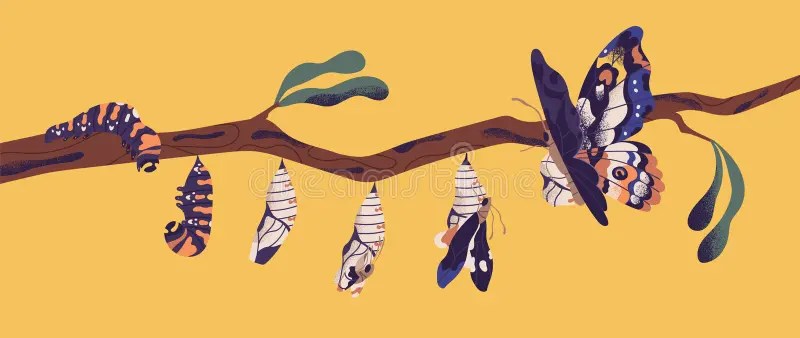
But I also read something the other day that I want to share, because I’m curious whether you’ll understand my perspective. It was something to the effect of: those who acknowledge themselves as butterflies don’t tolerate caterpillar people. And at first, I loved it. I thought its metaphor was clear, simple, and beautiful. But now I’m thinking that if we treat the two as mutually exclusive, it defeats the purpose of metamorphosis itself. The reason for the transformation.
There must be a reason, evolutionarily, why caterpillars fade into the dark, wrapped in isolation, only to break free through the excruciating effort of transcending their own unique perception of time and space, and quite literally take flight. If caterpillars and butterflies don’t speak, then they rob themselves of the opportunity to provide insight. To say, “Good things are yet to come. Hang on. Though you feel dark and alone, your greatest and most powerful change is still ahead.”
As I look forward to this next book, and as I hope to author many, I place this one on the shelf not with a sigh of defeat or a “thank goodness that’s over” type of remark, but with the recognition that metamorphosis is a continuation of my being. “Thank God,” said the butterfly, for the caterpillar’s efforts, for without them, its wings would never have come to fruition.
But I understand the point of the quote. Those who are matured and evolved should not necessarily trouble themselves with those who haven’t gone through that same maturation. I understand that perspective. But maybe that’s what the world needs: a bit more empathy, compassion, understanding — especially from those exquisitely beautiful butterflies out there. Sometimes their journeys have been some of the most difficult, yet they go unspoken because the image of their head held high is so powerful.
Also — slightly tangential, but not really, if you could have read through the inscribed thought-scroll dripping from my brain about fifteen minutes ago — what makes a good memoir? Is it relatable events? Funny anecdotes? Traumatic tales? Stories of woe and pain? Heartfelt remembrances? Reflections on past decisions? Dreams yet to be? Aspirations we’re still holding onto? What makes it palpable? What about life brings comfort to another? The sense of belonging? Acknowledgment? Validation? Maslow’s hierarchy of needs would probably summarize this with a simple, “Yes.”
So what makes a good memoir? Do you have to have a good story to tell? Or do you simply have to be a values-driven individual who believes in the dichotomy of the world — that life is as beautiful as it is miserable, as scary and horrifying as it is exquisite and magical? As Agatha Christie once said, “I like living. I have sometimes been wildly, despairingly, acutely miserable, racked with sorrow; but through it all I still know quite certainly that just to be alive is a grand thing.”
Only a butterfly with full acknowledgment and remembrance of its former caterpillar self has that level of self-actualization.
And maybe my path was meant to be this way. Maybe much of the self-actualization was meant to occur before the career. Maybe the generation-versus-stagnation debate is being fought ahead of its time.
But like Ms. Christie, I can think back on some of the most horrifying times in my life, even at the young age of thirty. I can look back on the trauma, the hurt, the heartache, and know for absolute certain that it is indeed a wonderful thing to be here, alive, and bringing free will to this earth.
Why not be completely and utterly myself? Why not make it all mean something?
That’s kind of the core of the butterfly effect: that no matter how small the toll of the bell, a reverberation will be heard. Your drops in the bucket matter. Your words matter. Your actions matter. Your emotions matter. It all matters, so much more than we can fully appreciate.
I think what makes a good memoir is the ability to craft a work of art that is thoughtful, unique, and articulate. Enough to be engaging. Enough for things to be well spoken and a story well told. But also raw, unprecedented, maybe even horrifying in its honesty.
I think writing the perfect memoir is not about disclosing one’s life or stories to another, but about furthering one’s self-actualization journey. To stretch our wings beyond once-comprehensible expansion. To take the time to bury oneself in isolation and actually feel everything once experienced, deeply, once again. To grab that old book off the shelf, dust it off, and flip through it with a newfound reflection.
Honestly, what makes a good memoir?
It’s understanding the purpose of the cocoon.
